
 Share
Share


))



HBO and The Ringer's Bill Simmons hosts the most downloaded sports podcast of all time, with a rotating crew of celebrities, athletes, and media staples, as well as mainstays like Cousin Sal, Joe House, and a slew of other friends and family members who always happen to be suspiciously available.
…
continue reading

Manage episode 522285174 series 3381925
Content provided by Meduza.io. All podcast content including episodes, graphics, and podcast descriptions are uploaded and provided directly by Meduza.io or their podcast platform partner. If you believe someone is using your copyrighted work without your permission, you can follow the process outlined here https://staging.podcastplayer.com/legal.
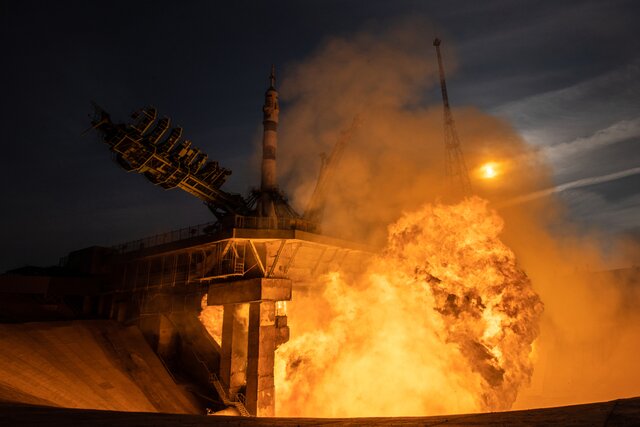
On November 27, the Soyuz MS-28 carrying a crew of cosmonauts lifted off from Site 31 at the Baikonur Cosmodrome, which Russia operates in Kazakhstan, on its way to the International Space Station. After the launch, scorched metal structures were discovered in the flame pit beneath the pad. It soon became clear that a crucial part of the launch system — a service cabin used by technicians to prepare the rocket — had broken off during liftoff. The damage has suspended all launches from the site and could have significant implications for the ISS’s operations. Meduza explains what happened and what this incident means for Russia’s space program.
Site 31 has a long and storied place in spaceflight history. It saw its first launch in 1961, and in the decades since, more than 400 rockets from the R-7 and Soyuz families have lifted off from this pad. The early missions carried only satellites, but Soyuz crewed spacecraft soon followed. And since 2020, Site 31 has handled all resupply launches to the Russian segment of the International Space Station after the backup pad — Site 1, known as Gagarin’s Start — was shut down.
The launch system for the R-7 rockets and their Soyuz successors is notably different from other launch tables. Here, the rocket doesn’t stand upright on the pad — it effectively hangs in place, held at its rigid “waist” by four counterweighted support arms. Beneath it is a flame duct that opens into a pit. To prepare the rocket for launch, a “service cabin” slides out from inside the flame duct like a giant drawer. This three-story metal framework gives technicians access to the engines from below. Forty-four minutes before liftoff, the cabin retracts into a niche in the structure, and a thick steel wall closes off the area on the engine side.
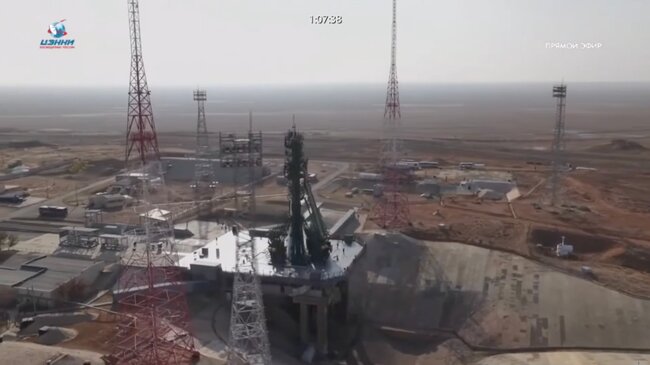
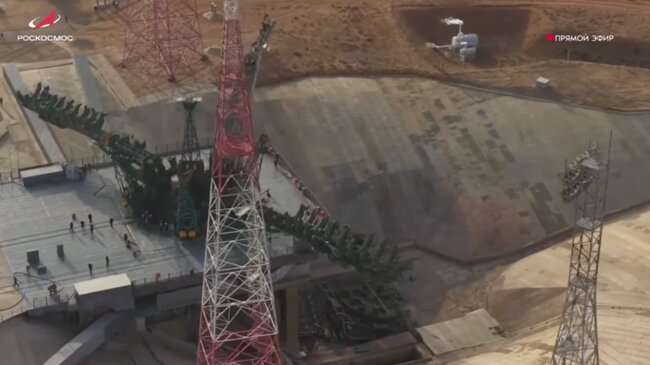
This time, it appears the service cabin either failed to retract fully or wasn’t properly secured in its niche. As a result, once the rocket lifted off, the cabin ended up at the bottom of the flame pit. That means that for now, Roscosmos, Russia’s state space corporation, has no way to launch another rocket from this pad.
Are there any alternative launch sites?
Russia does have other pads capable of launching Soyuz rockets — at the Vostochny Cosmodrome, at Plesetsk, and at the Guiana Space Center in South America. But none of them has ever been used for missions to the International Space Station.
- Plesetsk is ruled out for simple physics: its far-northern latitude makes ISS-bound trajectories impossible.
- The Soyuz pad in French Guiana has been mothballed since Russia and Europe ended their space cooperation in 2022.
- Vostochny, meanwhile, lacks the infrastructure needed to handle Progress cargo spacecrafts, and its launch facility isn’t yet ready for crewed Soyuz spacecraft.
The closest technical and geographic analogue to Site 31 is Gagarin’s Start (Site 1), but it, too, cannot currently accommodate the latest Soyuz model.
You’re currently reading Meduza, the world’s largest independent Russian news outlet. Every day, we bring you essential coverage from Russia and beyond. Explore our reporting here and follow us wherever you get your news.
A modernization of Gagarin’s Start for the upgraded Soyuz vehicles had been planned since 2019, as a joint project involving Russia, Kazakhstan, and the United Arab Emirates, with the UAE expected to fund the work. In late 2021, then–Roscosmos head Dmitry Rogozin said the Emirates were prepared to begin financing even before a formal interstate agreement was signed. But just a few months later, in April 2022, Rogozin conceded defeat: “Our hopes that the Russia–Kazakhstan–UAE triumvirate would deliver results and additional funding did not pan out… For now, I think Gagarin’s Start will stand as a reminder of the great Soviet space era — and as a reproach to those who turned space into an object of their political whims.”
Rogozin never explained which “political whims” he believed drove the UAE away. But he was likely referring to sweeping Western sanctions on Russia’s space sector after the invasion of Ukraine, coupled with Rogozin’s own retaliatory “counter-sanctions,” which pushed out nearly all existing and potential commercial clients for Russian launches — including OneWeb, the European Space Agency, and others.
In 2025, Gagarin’s Start was removed from Russian jurisdiction entirely and formally transferred to Kazakhstan, which plans to turn the historic pad into a museum complex. As a result, until Site 31 is repaired, Roscosmos has no technical means of launching people into space on its own.
What happens to the cosmonauts?
Since a fresh crew has just arrived at the International Space Station, there’s no need to launch another Soyuz for at least six months. In a pinch, Russia can even extend a crew’s mission from the usual six months to a full year — something that’s already happened several times before.
The bigger problem is cargo. The next Progress resupply mission, originally scheduled for December 19, will almost certainly be postponed, and the new launch date will depend entirely on how quickly the damaged pad can be repaired.
Basic supplies — like food, water, and hygiene products — can be delivered by American or Japanese cargo ships, so the station isn’t at risk of “going hungry.” But the Russian Progress vehicles also perform a critical technical role: they reboost the station’s orbit and help maintain its orientation. That can be done directly with Progress engines or by delivering propellant to the Zvezda service module’s tanks. For now, Zvezda still has fuel reserves, and some of these functions can be partially assumed by the American Cargo Dragon and Cygnus — something that’s already been tested. But if repairs drag on for six months or more, Zvezda’s fuel shortage will become a real issue, and it won’t be Roscosmos’s problem alone. Elon Musk would likely jump at the chance to take over the work, and NASA would become even less dependent on Russian systems for station operations.
Roscosmos’s official statement on “damage to several elements of the launch table” claimed that all necessary spare parts are available and that repairs will be completed “in the near future.” However, it’s likely that even inside the agency no one knows what “near future” actually means. It’s also doubtful that “necessary elements” for a structure built in 1961 are truly sitting in storage. Most likely, Roscosmos will have to remove the similar service cabin from the now-inactive Gagarin’s Start — Kazakhstan’s future museum — though some components may still exist from the more recent construction of the Vostochny Cosmodrome.
Ultimately, the damage isn’t catastrophic for Roscosmos or for the ISS, and it won’t significantly affect Russia’s crewed program over the next year. But it does expose a deeper vulnerability: Russia’s entire human spaceflight infrastructure — its ISS operations today and its ambitions for a future national orbital station — now depends on a single 64-year-old launch pad located in another country.
space and the law
64 episodes


