Share
Share


))



HBO and The Ringer's Bill Simmons hosts the most downloaded sports podcast of all time, with a rotating crew of celebrities, athletes, and media staples, as well as mainstays like Cousin Sal, Joe House, and a slew of other friends and family members who always happen to be suspiciously available.
…
continue reading

Manage episode 522194305 series 3381925
Content provided by Meduza.io. All podcast content including episodes, graphics, and podcast descriptions are uploaded and provided directly by Meduza.io or their podcast platform partner. If you believe someone is using your copyrighted work without your permission, you can follow the process outlined here https://staging.podcastplayer.com/legal.
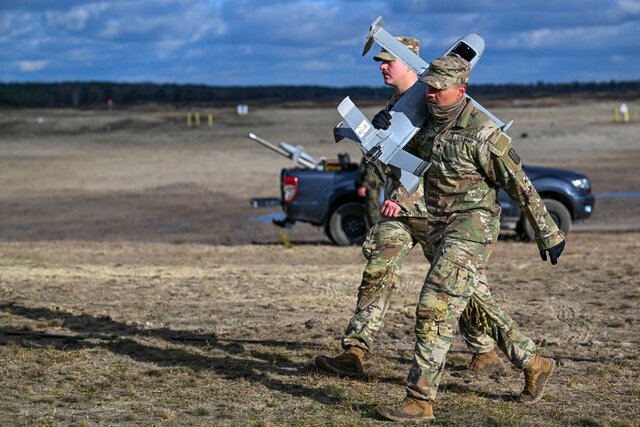
Europe is stepping up its preparations for a possible war with Russia. Debates over how to strengthen the continent’s defenses intensified starting in mid-September, when roughly 20 Russian drones entered Polish airspace. Then, in the two months that followed, unidentified drones repeatedly appeared over airports and military sites in Germany, Denmark, Belgium, and Norway. In response, Brussels announced plans in October to build a “drone wall” to protect European airspace, with the system slated for completion by 2027.
Meduza spoke with Meduza spoke with German military expert Frank Sauer, the head of research at Bundeswehr University’s Metis Strategy Institute in Munich, about why “drone wall” is a misleading term , what the Kremlin hopes to gain from its airspace incursions, and why Germany remains a weak link in European defense.

— What is exactly is a “drone wall”?
— In early 2025, European politicians used the term “drone wall” literally. They meant “a wall made of drones.” The idea was to buy lots of drones of different types and direct them at the enemy. In theory, the “drone wall” would allow the E.U. to quickly deter aggression — for example, in the event of a Russian tank attack on Lithuania. But since then, the term has taken on a new meaning: a “wall against drones.” Now, by “drone wall,” people mean a system for detecting aerial targets that determines a drone’s type, speed, and flight altitude [in order to destroy it].
In reality, the term “drone wall” in the sense of a “wall against drones” doesn’t make sense and is misleading. First, “drone” is an imprecise term. It covers everything from small quadcopters flying no higher than two meters to large fixed-wing UAVs — like the Russian Gerbera drones that entered Polish airspace. All these types of drones require different defense methods. Second, the phrase “wall against drones” creates the impression that the E.U. is building a robotic Maginot Line. Of course, E.U. countries need a layered air defense system. But the idea of a protective barrier behind which one can be safe is flawed. Victory can’t be achieved through defense alone.
— Presumably, E.U. defense ministers understand that. So is their proposal more of a political gesture?
— These kinds of statements show that the E.U. is a structure that doesn’t cope well with urgent security crises. The Union delivers real results mainly in complex negotiation processes because it’s always striving for compromise and the broadest possible consensus. That is, in many ways, the E.U.’s strength — this approach helps balance interests. But that same pursuit of compromise limits the E.U.’s ability to make security decisions.
The drone revolution
— Yet the E.U. wants to integrate the air defenses of all European countries. Would such a major step require a centralized operational command, which it currently lacks?
— It does exist — just not at the E.U. level. It exists at the NATO level: NATO’s Integrated Air and Missile Defense. One may doubt how well that structure works, but the concept itself certainly exists. Normally the E.U. doesn’t create structures that NATO already has. But because of the actions of the Trump administration, there’s strong chance that the E.U. — or, rather, a coalition of certain European countries — will take air-defense management for all of Europe into its own hands.
— The E.U. also includes Hungary and Slovakia, whose leaders sympathize with Russia. It seems that, in the event of an attack by Russian drones, these countries would be “weak links.” How should a country like Germany react, given that its defense depends on their airspace?
— This situation makes it very clear that Europe’s defense shouldn’t be handled by the E.U. Hungary, for instance, regularly blocks various initiatives aimed at countering Russian aggression.
But Europe’ s main task now is to deploy air-defense systems in those E.U. countries that actually need them, and this process has been underway for a long time. For example, NATO countries deployed additional fighter jets in the Baltics and Poland after violations of their airspace by Russia. Dutch and Italian F-35s have helped intercept drones in Poland and Russian MiGs over Estonia.
— Shooting down cheap drones with expensive fighter jets is hardly cost-effective, which is why the E.U. says it wants to learn from Ukraine’s experience, where drones knock out mobile air-defense groups. Does the E.U. need these kinds of units?
— Yes and no. Ukraine did shoot down Russian drones using improvised means — like small-caliber weapons mounted on pickup trucks. But that tactic barely works now, because Russia has adapted its Geran-2 and Gerbera drones, and they now fly at higher altitudes.
More powerful ground systems can still shoot down these drones without using expensive missiles. But their range is only a few kilometers, so you simply can’t cover the entire E.U. with them. As I’ve already said: there’s no such thing as 100 percent protection; no wall is impenetrable.
Read more about drone warfare in Ukraine
— So how should Europe defend itself?
— The best defense is to neutralize the source of the threat. Ukraine demonstrates this clearly — it’s no coincidence that it relies on precision strikes deep inside Russia. So E.U. countries shouldn’t be thinking only about how to repel drone raids, but asking other questions: Where are Russian forces launching their drones from? Where are the factories that produce them?
— So Europe should focus less on defending against drones and more on striking the places where they’re made?
— Experts have long been discussing both options. There’s even a European defense project to develop long-range precision weapons — and it’s far from the only program like that. But there’s another question: does the public understand how important such strikes are?
If the E.U. limits itself to defense, it will lose the war — even if perfect, 100-percent-effective defense were possible. Defense is always more expensive than attacking with large numbers of disposable systems. So relying on defense alone is a recipe for economic ruin. Besides, the E.U.’s goal is to prevent an attack in the first place. The whole point of these measures [to counter Russian aerial aggression] is to signal to Russia that Europe is no longer vulnerable.
The E.U. wants the Kremlin’s imperial ambitions to end at NATO’s borders. To achieve that, it’s not enough to protect airspace. Europe must also be able — as a next step — to destroy the launch platforms. That’s the only way to change the Kremlin’s calculation of costs and benefits.
You’re currently reading Meduza, the world’s largest independent Russian news outlet. Every day, we bring you essential coverage from Russia and beyond. Explore our reporting here and follow us wherever you get your news.
— Could the Kremlin’s incursions also have had a psychological goal? For instance, to spook the E.U. and distract it from defending Ukraine?
— Absolutely. The Kremlin wants to sow discord between Ukraine and its allies. It also wants to create rifts among Western countries themselves. When Russian fighter jets violated Estonian airspace, it triggered intense debate over whether they should be shot down.
Some states would likely support shooting down the jets if it happened again. That would ignite a fierce discussion within NATO about the risks of starting a third world war. So from the Kremlin’s perspective, such provocations make perfect sense: they highlight how divided NATO is. Europe’s main problem isn’t a shortage of drone detectors. It’s a political problem — Europe isn’t united enough.
— How can cohesion within NATO and the E.U. be strengthened?
— When Russian fighter jets violated Estonian airspace, I was in Finland at the Helsinki Security Forum. There, the commander of the Finnish armed forces said that under no circumstances should Russian jets be shot down. And Finland takes a very tough line toward Russia. They’re so well prepared for conflict that they don’t need to prove their defensive capability.
That’s precisely why Finns are calm: they know they can defend themselves if attacked, and they refuse to fall for Kremlin provocations. Germany, by contrast, has become used to thinking that its armed forces are poorly equipped. That gives it more reasons to worry — and Russia can exploit that. I would like all of Europe to be able to defend itself, because that creates confidence.
— Some politicians say that Europe must be ready to repel a Russian attack by 2029. But German foreign intelligence service head Martin Jäger believes Europe is already in danger. Do you agree with him, or do you think Europe has time to strengthen its defenses?
— I agree with Jäger. Ever since Russian military equipment entered European airspace, the conflict has reached a new level — beyond mere sabotage and disinformation. Moreover, the problem of EU countries’ unpreparedness will not become serious in 2029, but, on the contrary, it will be particularly acute before that. After all, until 2029, Donald Trump will be President of the United States, and Europe will not have had enough time to sufficiently strengthen its defenses.
What European states fear isn’t a full-scale third world war, but rather some kind of “test” by the Kremlin — a move designed to expose the E.U.’s internal divisions. And before 2029, Russia certainly has the opportunity to stage such a “test.”
— Jäger has warned about this as well. He says Russia wants to intimidate Europe and force it to “give up prematurely.” Do you think Europe is really ready to surrender without a fight?
— Definitely not. Defense capabilities aren’t improving as quickly as we’d like, but they are improving, and on many levels. You can see this even in Germany — although Germany is one of the most hesitant E.U. states with regard to Russia, and therefore a prime target of Russian disinformation.
— Why is Germany so hesitant?
— Because for decades, the Germans pursued a policy toward Russia that didn’t match reality. Our view of Russia was based for far too long on the blind hope that Vladimir Putin was a friend of Europe who wanted peace.
But that was never true. For example, back in the early 2000s, Putin addressed the German parliament in German talking about peace — shortly after leveling Grozny. Yet the belief that Putin sought peace became deeply embedded in German political culture. We deceived ourselves about Russia and peaceful coexistence in Europe for far too long.
The drone war
Interview by Alexander Eidlin
64 episodes